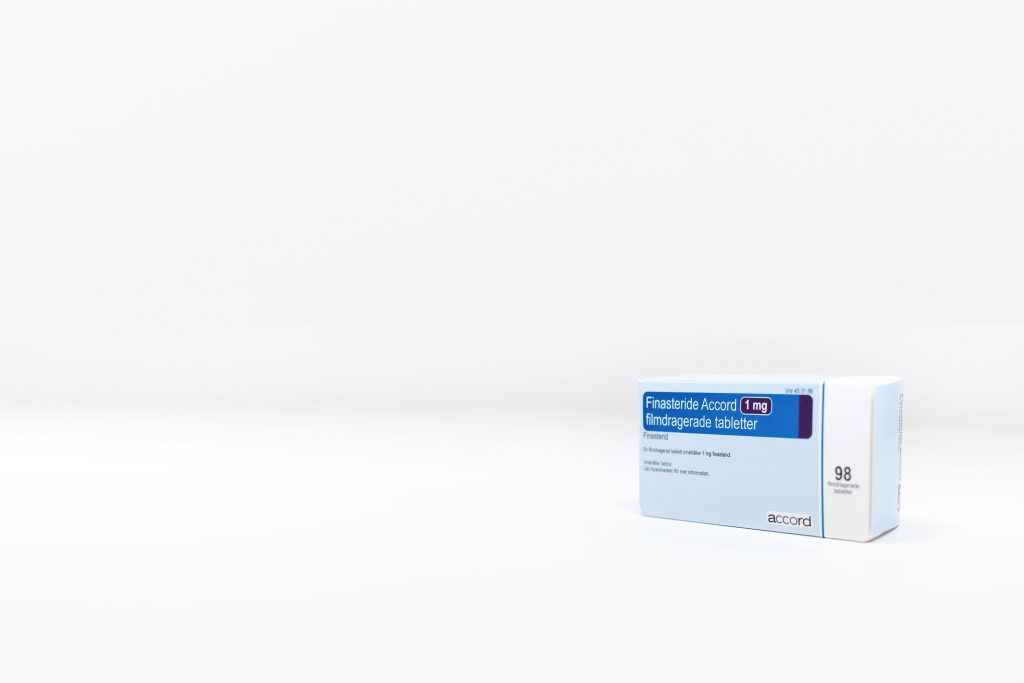
Finasteride (or Finasteride in English) is a drug approved to treat hereditary male hair loss, that is, when the hair becomes thinner and eventually begins to fall off due to genetic factors.
Finasteride exists in cutaneous solution (a foam applied to the scalp), but it is not approved in Sweden. In Sweden, Finasteride is sold under different names, such as Finasteride Accord and Propecia, but there are also cheaper generic variants, such as Finasteride Stada.
.jpg)

What is Finasteride good for? Finasteride blocks an enzyme that converts testosterone to DHT. When the body has less DHT, the hair follicles are not affected as much and hair loss slows down. In many men, the hair can become thicker again and in many, even new hair can begin to grow.
How fast does Finasteride work? Results from treatment can be seen after about 3 to 6 months, but it often takes a year to see the full effect. It is important to continue the medication every day because the effect disappears if you stop — then the hair usually starts to fall out again as before the treatment.
When taking Finasteride to counteract thinning hair, one film-coated tablet of 1 mg is usually taken every day. It does not matter if you take the tablet with or without food, but it is good to try to take it at the same time every day to remember it more easily.
If you forget a tablet one day, do not take a double dose the next day, but continue with the usual dose. The medication is only approved for men and should not be used by women or children. Pregnant women should avoid handling crushed or split tablets because the active substance can be absorbed through the skin and harm the fetus. Men planning pregnancy with partners should discontinue treatment.
The vast majority can take Finasteride and is taken primarily by people being treated for male pattern baldness. However, there are various factors that make treatment less appropriate and you as a user need to know before starting treatment.


Does finasteride have bad side effects? Most people who use finasteride experience no or only mild side effects, but some men may experience problems, usually at the beginning of treatment. Users do not need to be affected but some experience sexual side effects primarily.
The side effects of finasteride usually go away on their own. If you experience side effects that do not go away or that feel painful, you should always contact your doctor or other healthcare professional.

It is a good idea to use Finasteride together with PRP (platelet rich plasma) to counteract thinning hair. PRP is a treatment in which blood plasma is used to stimulate the hair follicles.
Finasteride makes hair follicles stronger and more susceptible to PRP, which can make treatment produce better and clearer results. Many people who do PRP against thin hair combine it with finasteride to get the maximum effect.
Here you can see the most common questions we get about the medicine.
Yes, it is common to combine finasteride with other treatments, such as hair transplantation, minoxidil or PRP (Platelet Rich Plasma) treatments. Consult your doctor to find the best treatment plan for your specific condition.
No, finasteride is not recommended for women, especially for pregnant women or those planning to become pregnant, as the drug may affect fetal development. For women, there are other treatment options for hair loss, such as minoxidil or PRP treatments.
It can take up to six months to achieve full effect. Therefore, we recommend that you continue taking the medicine even if you do not see any improvement at once.
Yes, finasteride is covered by the high cost protection in Sweden, but this mainly applies to the treatment of benign prostatic enlargement at a dose of 5 mg. In contrast, finasteride 1 mg, which is intended for the treatment of male pattern baldness (androgenic alopecia), is not subsidized and is not part of the high cost protection.
No, the medicine is only available with a prescription. If we decide that this would be a good solution for you, we can help you print a recipe. We then do this for an administration fee.
Finasteride is primarily used to treat hair loss in men, specifically male hereditary hair loss (androgenic alopecia). The drug works by inhibiting the enzyme 5-alpha reductase, which reduces the conversion of testosterone to DHT -- the hormone that greatly contributes to hair loss. Many men in Sweden use finasteride to slow or counteract thinning of the hair, especially on the head and upper part of the head.
Pregnant women should absolutely not use, handle or come into contact with crushed or broken tablets, as finasteride can affect the sexual development of a male fetus. Therefore, finasteride in Sweden is strictly prescribed and subject to medical assessment.
In addition to that, men with liver diseases, hormonal imbalance or mental illness should be careful. This is because finasteride can cause side effects — such as decreased sex drive, erection problems or depressed mood —. Some users have even reported long-term side effects, although these are uncommon.
In most cases, transgender people have undergone or are undergoing some type of hormone therapy to confirm their identity. Finasteride works by blocking the hormone DHT and we cannot guarantee that Finasteride will not interfere with a trans person's ongoing or already completed hormone therapy. We refer instead to consulting your treating doctor if Finasteride is a good idea for you.
Dosage is too high — For the treatment of hair loss, 1 mg has been shown to be effective enough with the least possible risk of side effects. Higher doses (e.g. 5 mg) do not necessarily produce better hair growth, but may increase the risk of side effects such as decreased ibido and erection problems.
BOOK CONSULTATION
Free consultation — no obligation, just a first step towards understanding what's right for you. Choose the clinic that suits you best.