At one Hair Transplant hair is moved from an area rich in hair to an area where increased hair growth is desired. The transplanted hair follicles grow firmly within 24 hours and immediately begin to produce a naturally growing hair. The hair transplant is always performed under local anesthesia and the technique that almost all hair clinics uses called FUE, which you can read more about below.
.jpg)


A hair transplant is a gentle and carefully planned treatment in which we move hair follicles from an area of good hair growth to the parts where the hair has become thinner. The process always starts with a personal consultation where we analyze your hair, your goals and what results are realistic for you.
1

A hair transplant always starts with a free consultation where we go over your personal circumstances.
2
On the day of the hair transplant, it is important that you start the day by eating a steady meal so that you have plenty of energy for the procedure. We recommend that you wear comfortable clothes as well as a blouse or shirt so that you do not have to wear anything over your head when the procedure is finished. When you arrive at the clinic, you are allowed to change into an operating gown. Next, together we go through the different parts of the procedure and what will take place.
3
A drawing is made around the transplant area. You'll now get to see where your new hairline will sit. Should you want to make any adjustments to the shape or placement, we'll talk through those decisions in peace and quiet. You always have the final say when it comes to what your new corrected hairline should look like.
4
The next step is to prepare the donation area. It is from this area that your hair follicles will be plucked from.The area is marked out and shaved. Many people choose to shave their entire head, depending on how large the donation area is and how long your hair is.However, we would love for you to come unshaven to the clinic the day of your hair transplant so that we can see how your hair grows.
5
You may lie face down on the treatment bed. After that, local anesthesia is injected into the donation area.
It will take a few minutes for the area to be numbed and it will sting a little in the meantime. First, we mark on the skin which area to treat and where the local anesthetic should be put. Then we wash the area with iodine. We want a clean skin surface without bacteria to minimize the risk of dirt coming down the lair. Next, we inject the local anesthetic which consists of two different preparations: fast-acting Carbocaine and long-acting Marcain. The short-acting preparation allows us to start the procedure immediately and the long-acting means that the effect lasts even after the procedure has been done.This step can be felt a little. But after that, the procedure is completely painless.
6
To be able to extract the hair follicle groups, we drill them loose, one by one. Each graft is then plucked out of the donation area with tweezers. Grafts with different numbers of hair follicles are removed to give you as natural a result as possible.
7
After all grafts have been removed from the donation area, you are allowed to turn around and receive local anesthesia in the transplant area.After that, small channels are created in the transplant area in a slight irregular pattern in order for the hair to mimic your natural hair as much as possible.This is the most difficult moment in a hair transplant. It requires a lot of knowledge, accuracy and good technique. This moment is decisive for how the result will be.
8
Vaseline is added to the donation area to create an extra layer of protection against dirt. In the donation area, the wounds are larger than in the newly transplanted area, where only small incisions have been made. Bandages are put on over the donation area to be sat on for 24 hours. The newly transplanted area must not be bandaged because it is a very sensitive area and must be healed undisturbed.
9
Once your hair transplant is complete, we will go through aftercare and medicine with you. You will find out how to wash, when to start wearing a cap again and what to think about when it comes to exercise and alcohol.We also adjust the time for follow-up with PRP included in your aftertreatment to speed up the healing process.

FUE hair transplantation, or Follicular Unit Excision, is a modern method in which individual hair follicles are taken from a donor area and placed in the areas where hair loss emerged. The technique leaves minimal scars and gives a natural result, as the hair follicles are planted individually with high precision.
When everything heals, there are no marks or scars left, neither in the area from which the hair follicles were taken, nor in the area to which the hair follicles were transplanted. The most common technique involves shaving the donated area of the neck before the hair follicles are removed.
We work with FUE technology and DHI technology at Nordic Hair Clinic. The transplants are administered and performed by our surgery team.
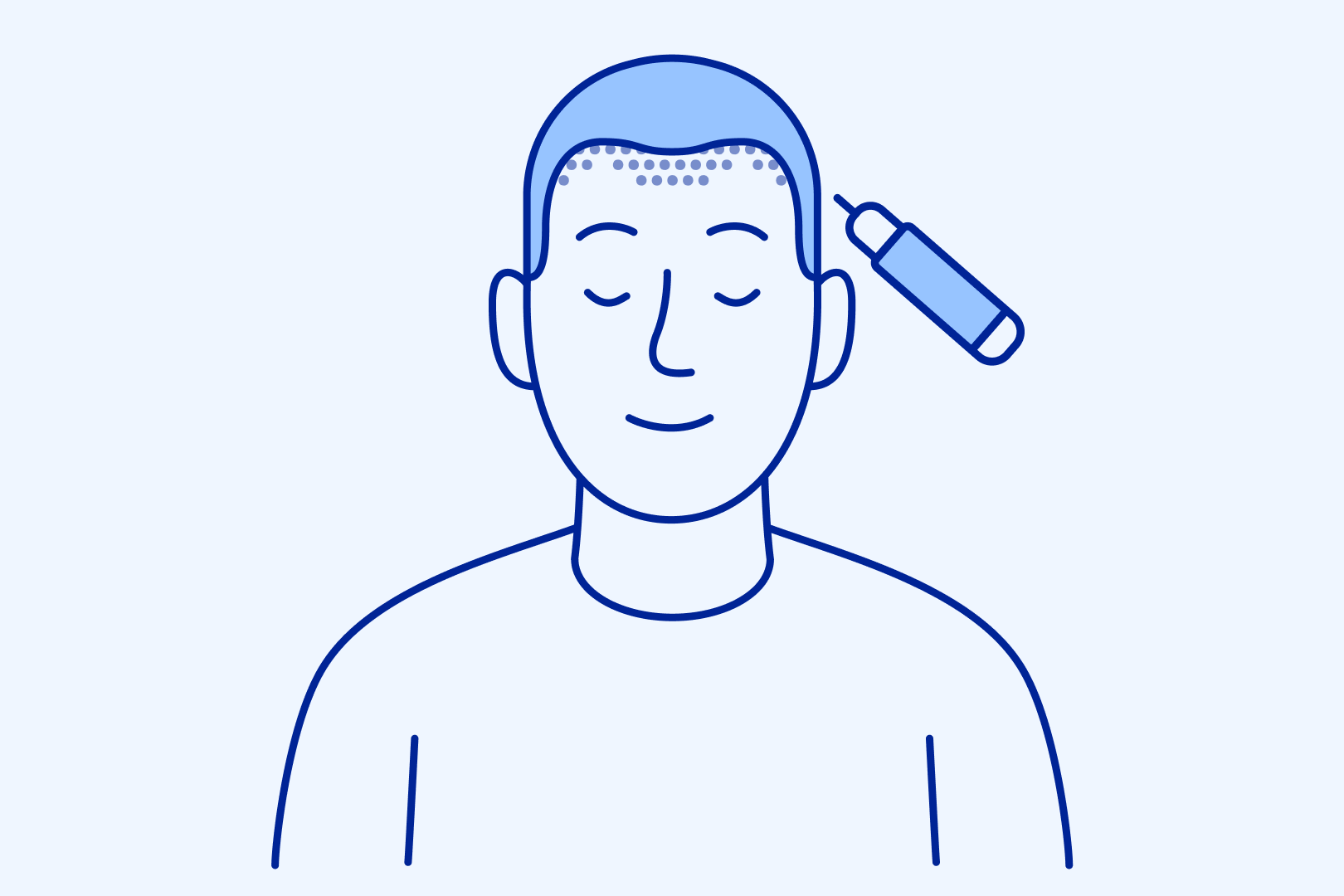
Direct Hair Implantation (DHI) is an advanced technology for hair transplantation that relies on hair follicles being extracted and implanted directly into the receiving area without the need for prefabricated channels. The hair follicles are taken individually from the donor area, usually the back of the head, and then placed using a special implant pen called the Choi-pen. This pencil allows the staff to position the hair follicles with great precision in terms of depth, angle and direction, producing a natural and aesthetically pleasing result.
One of the main benefits of DHI is that it reduces trauma to the scalp and leads to faster recovery. However, the technique is more time consuming and more expensive than traditional methods such as FUE (Follicular Unit Extraction).

Book consultation
Free consultation — no obligation, just a first step towards understanding what's right for you. Choose the clinic that suits you best.