






To awaken dead hair follicles
Awakening dead hair follicles can be possible through various treatment methods. PRP (Platelet-Rich Plasma) therapy uses the patient's own blood to stimulate hair growth by injecting concentrated platelets into the scalp. Other effective methods include laser therapy, microneedling, and the use of hair growth stimulants such as minoxidil. Consult a doctor to find the best treatment to reactivate hair follicles.
Getting lost hair back
Regaining lost hair can be achieved through various treatments such as minoxidil, PRP (Platelet-Rich Plasma) and hair transplants. Minoxidil is applied directly to the scalp and stimulates hair growth. PRP treatments use your own blood to promote hair growth and improve the health of hair follicles. Hair transplants involve moving hair follicles from an area of dense hair growth to areas of hair loss to create a natural hair regrowth.
How to increase hair growth on the head
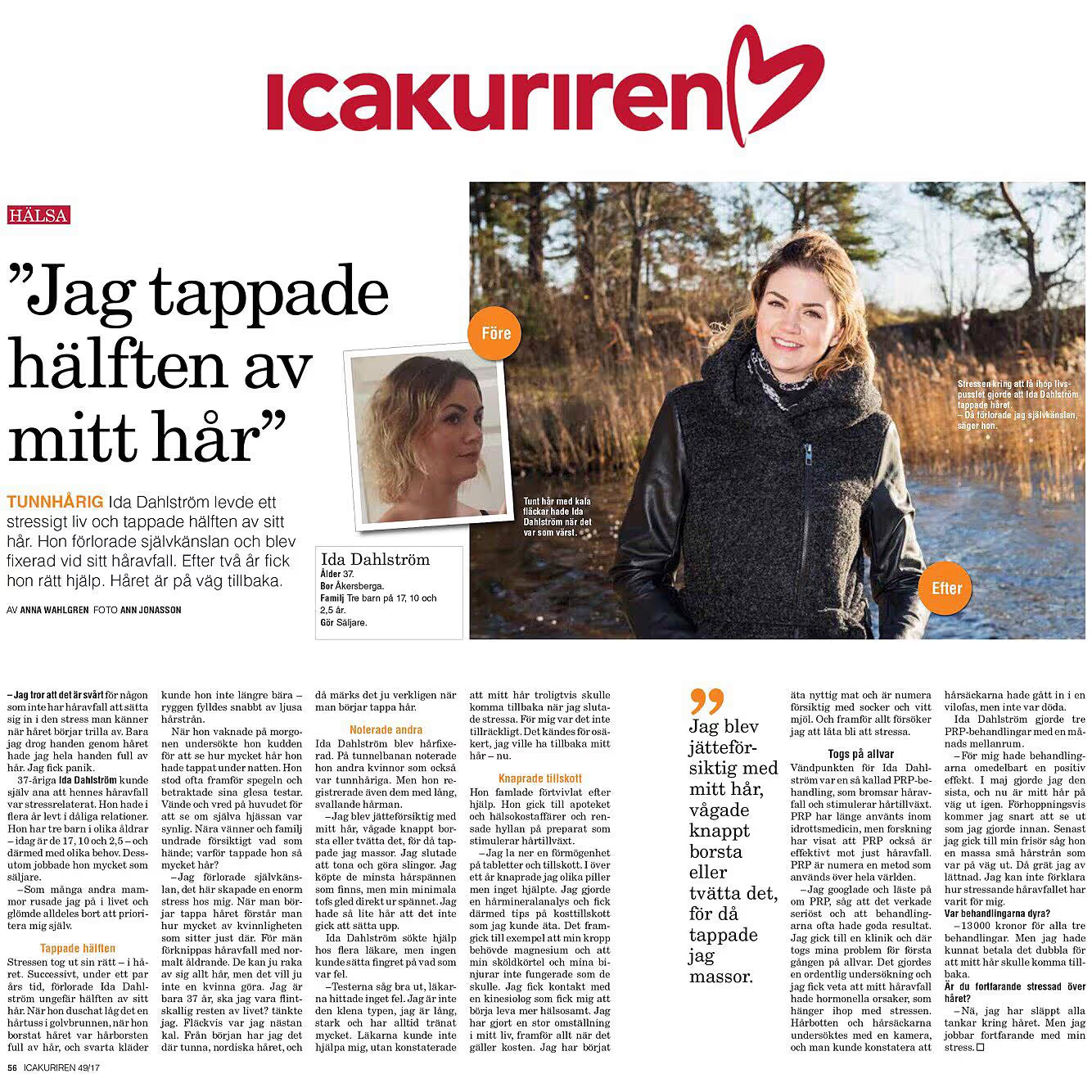
To increase hair growth on the head, you can follow several effective methods. A balanced diet rich in vitamins and minerals, especially biotin, zinc and vitamin D, can stimulate hair growth. Regular massage of the scalp improves blood circulation and promotes the health of hair follicles. Using products such as minoxidil and PRP treatments have also been shown to be effective in increasing hair growth.— I think it's hard for someone who doesn't have hair loss to put themselves into the stress you feel when hair starts to fall off or when hair goes off in the middle of the head. Just pulling my hand through my hair I had my whole hand full of hair. I panicked,” says Ida. Ida Dahlström, who lives in Åkersberga outside Stockholm, could see for herself that her hair loss was stress-related. For several years she had been living in bad relationships.She has three children of different ages — today they are 17, 10 and 2.5 years old — and who thus have different needs. In addition, she worked a lot as a salesman.— Like many other mothers, I rushed on in life, and completely forgot to prioritize myself.Read more about how stress affects hair lossThe stress took its toll -- in the hair. Gradually, over the course of a couple of years, Ida Dahlström lost about half of her hair.When she showered, there was a hairpin in the floor drain, when she brushed her hair, the hairbrush was full of hair, and black clothes she could no longer wear — her back was quickly filled with light hairs.When she woke up in the morning, she examined the pillow to see how much hair she had lost during the night. She often stood in front of the mirror and watched her sparse tests.She turned and turned her head to see if the head itself was visible. Close friends and family gently wondered what happened -- why did she lose so much hair? “I lost my self-esteem, this created a huge amount of stress for me. When you start losing your hair, you understand how much of the femininity is sitting right there. For men, hair loss is associated with normal aging. They can shave off all their hair, but a woman doesn't want to do that. I'm only 37, I'm going to be bald for the rest of my life, I thought. At times, I was almost bald. From the beginning I have that thin, Nordic hair, and then it really becomes noticeable when you start to lose hair, Ida tells me. Ida Dahlström became fixated on hair and everything started to be about how to get her hair back and what could be the best way to get her hair back.On the subway she noted other women who were also thin-haired. But she also registered those with long flowing hair.— I was very careful with my hair. I hardly dared to brush or wash it, because then I lost a lot. I stopped tinting and making loops. I bought the smallest hairpins available for purchase, but my minimal tassel slipped right out of the buckle. I had so little hair that it could not be put up.Ida Dahlström sought help from several doctors, but no one could put their finger on what was wrong.— The tests looked good, the doctors found nothing wrong. I'm not the skinny type, I'm tall, strong and have always trained a lot. The doctors were unable to help me, but concluded that my hair loss was due to stress and that my hair would most likely come back when I stopped stressing. For me, it wasn't enough. It felt too unsafe, I wanted to get my hair back — now.She desperately groped for help. She went to the pharmacy and to health food stores and cleared the shelves of preparations that stimulate hair growth.— I spent a fortune on tablets and supplements. For over a year I nibbled on various pills that would help stimulate hair growth. Maybe my hair loss was due to iron deficiency? But nothing helped. I did a hair mineral analysis and thus got tips on supplements that I could eat. It became clear, for example, that my body needed magnesium, and that my thyroid and adrenal glands were not working as they wanted.— I got in touch with a Kinesiologist who made me start living more healthily. That was positive in itself. I have made a big change in my life, especially when it comes to diet. I've started eating healthy foods, and I'm now wary of sugar and white flour. And above all, I try not to stress.The turning point for Ida Dahlström was a so-called PRP treatment, which slows hair loss and stimulates hair growth.PRP has long been used in sports medicine, but research has shown that PRP is also effective against hair loss. PRP is now a method used all over the world.— I googled and read about PRP and saw that it seemed serious and that the treatments often had good results. I went to Nordic Hair Clinic and there my problems were taken seriously for the first time. There was a proper examination and I was told that my hair loss had hormonal causes, which are linked to the stress. My scalp and hair follicles were examined with a camera, and it could be ascertained that the hair follicles had entered a resting phase, but that they were not dead.How PRP works in the hairIda Dahlström did three PRP treatments one month apart.— For me, PRP immediately had a positive effect. In May, I did the last treatment, and now my hair is on its way out again. Hopefully I will soon look like I did before I started losing the year. Last time I went to my hairdresser she said she saw lots of little hairs coming out. Then I cried with relief. I can't explain how stressful the hair loss has been for me.Were the treatments expensive?— 13 000 SEK for all three treatments. But I could have paid double that for my hair to come back.Are you still hair-stressed?No, I've released it now. I don't think about my hair at all, which is positive in itself. Stress contributes to the loss of more hair.What does it cost to do PRP treatment
“In most cases, help is available.
Don't go around for years worrying about your hair loss. Seek help in time. This is hair specialist Mats Stolt's best advice.Trying to treat himself and his hair loss, and self-medicate with various tablets, vitamins, shampoos and oils, without finding out what the hair loss really depends on, he does not recommend. It can even complicate the possibilities of appropriate and effective treatment to bring back lost hair.— I meet women who have been losing hair for many years, sometimes for decades. They have carried on so much worry. It is unnecessary. Getting a message about what hair loss is due to and what you can do about it makes most people calm and safe. Releasing the hair stress in itself has a positive effect on the hair. Dealing with women's concerns is thus an important part of treatment,” says Mats Stolt, biochemist and clinic manager at Nordic Hair Clinic, one of Europe's largest hair clinics specializing in hair loss.First of all, the cause of the hair loss must be localized.— Has the patient had dengue fever? Exposed to shock? Iron deficiency? Problems with the thyroid gland? Many patients are sent to the medical center to take a blood test and check their values,” says Mats Stolt.Female hair loss differs from male hair loss, both in terms of causes and appearance — in women, hair is usually thinned on the upper third to half of the scalp. Heredity is the most common cause of male hair loss. For women, the causes are more complex, and often the hair loss is a combination of several factors.Stress, hormonal changes, iron deficiency, pregnancy, and problems with the thyroid gland are common reasons. With advancing age — sometimes as early as their 40s — many women get thinner hair.The hairs become wicker, alternatively the hair follicles produce fewer hairs. But the result is the same: a feeling of significantly less hair.Stress is a decisive factor. Many women come to the clinic who have experienced stress for a long time — both in life and over their hair loss. Project managers and teachers are the most common professional groups — typical professions where it is difficult to influence their work situation. Young career women between the ages of 30 and 40 who work a lot, have a family and train hard are yet another common patient group.— If you add stress to an already existing iron deficiency or hormonal change, there is a great risk of hair loss, says Mats Stolt.Working a lot is not dangerous in itself. As usual, it is the deep, molting stress that affects the body—and the hair.— to lie awake at night contemplating the relationship. Constantly thinking about their job. Stress seems to take a harder toll on women than on men. We almost never see men with stress-related hair loss. Quite often, we actually recommend our clients to go to CBT therapy to get control of the stress. CBT helps against stress, and therefore against hair loss,” says Mats Stolt.Many women are also helped by PRP, an effective form of treatment to restore lost hair. PRP has been widely used for several decades in sports medicine, and to treat osteoarthritis. Nowadays it is a common method worldwide to stimulate and increase hair growth.The person is dropped on a tube with blood that is centrifuged to separate the plasma with a lot of platelets, known as platelets, from the rest of the plasma and from the red blood cells.The platelets consist of a large amount of growth factors, a kind of body-like protein with a positive impact on the activity of the hair follicles. The blood plasma is injected with several small pricks into the scalp in selected areas.See step by step how a PRP treatment is done“Many of our customers respond well to PRP. The result is individual, but three treatments are common. In almost all cases, hair loss is slowed down, but very many get back lost hair,” says Mats Stolt.What about supplements?“If you have iron deficiency, you should of course take iron tablets, and those who have problems with the thyroid gland are usually given Levaxin. As for regular dietary supplements, I am doubtful. Few people in Sweden suffer from nutritional deficiencies. If you are newly immigrated from Syria or another war zone, then yes. Then vitamins may be needed to balance up a body. Otherwise, my experience is that dietary supplements have a marginal effect on hair loss,” says Mats Stolt.He wishes more people knew that they could get help: “In the vast majority of cases, there is a solution. Not all women can get their hair back, but hair loss can almost always be slowed down. Just the fact that you stop losing the existing hair allows women to let go of their hair loss, focus on other things, and get back a good quality of life,” says Mats Stolt.
Most common causes of female hair loss
- Stress
- Disorders of the thyroid gland
- Iron deficiency
- Hormonal changes
- Heredity
- Menopause
- pregnancies
- Medications
- The skin disease Alopecia Areata (Spotted hair loss, an autoimmune disease, closely related disease is Alopecia Totals, when all hair on the body disappears.)
- Telogenic Effluvium (The body goes through traumatic experience, difficult surgery, heavy infection, extreme stress, and the hair follicles go into resting phase and the hair falls off.)
How is female hair waste treatedIron tablets/ iron syringes: For those who have iron deficiency.The drug Levaxin: For those who have thyroid problems.The drug Minoxidil: Sold in Sweden under brands such as Rogaine, Recrea and Orifarm. Increases the diameter of blood vessels and provides increased blood flow. The dilated blood vessels provide the hair follicles with more oxygen and allow nutrients to reach the area.The drug Finasteride: Used in Sweden only on men.PRP Treatment: Stimulates the new formation of small blood vessels, and triggers inactive hair follicles to enter an active growth phase. When dormant hair follicles are activated, the number of hairs that grow increases.CBT therapy: Effective against stress, and therefore against hair loss.

