





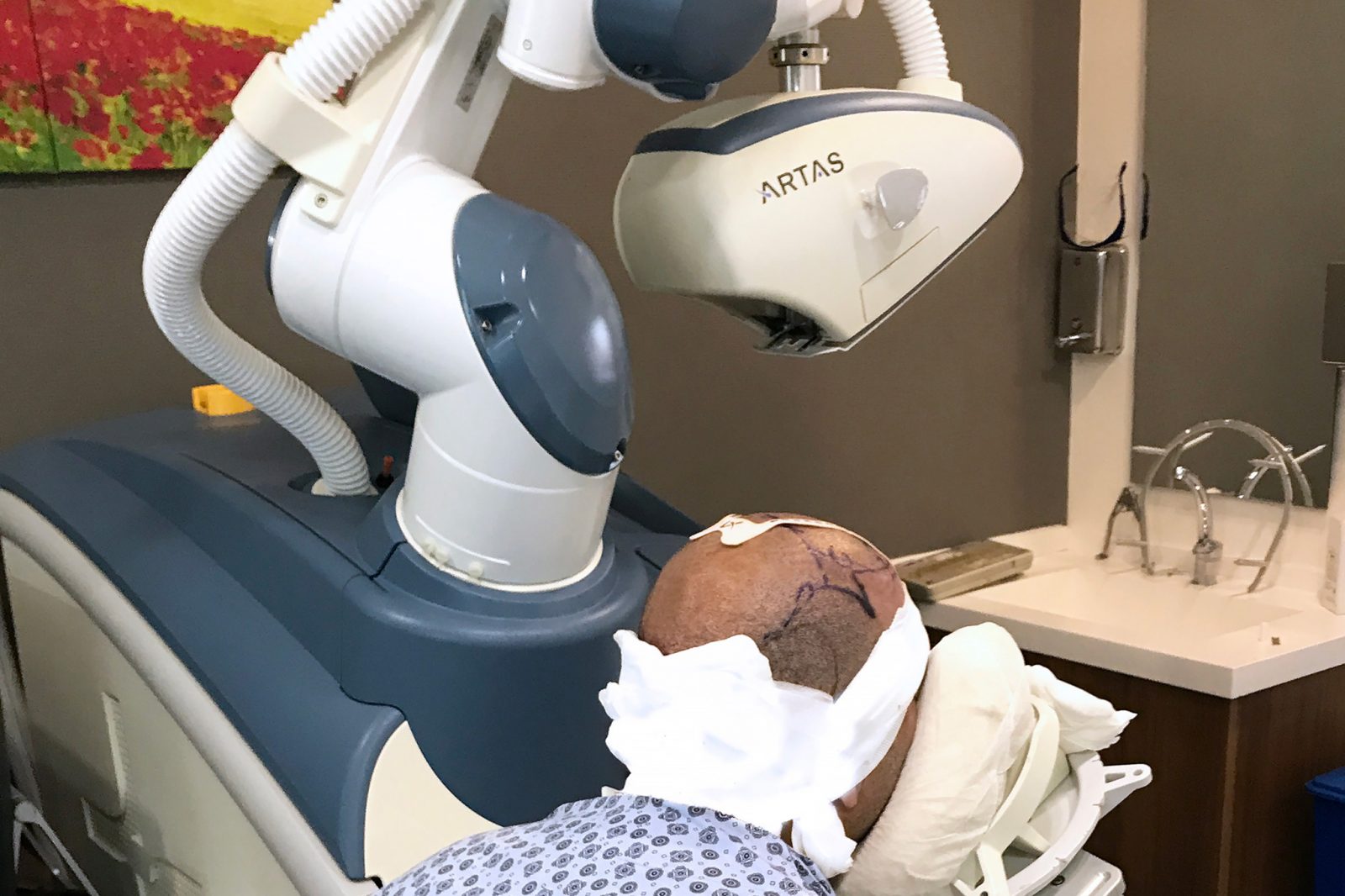
Robotic surgery
Robotic surgery in Hair Transplant is not as futuristic as cloning and gene therapy. ARTAS is the name of a robotic system that today can perform the extraction and insertion of hair follicles — completely automatically. The system is an automated method that uses specialized technology to perform the hair transplant. Technically, ARTAS is not a surgical procedure and is considered minimally invasive. The system requires neither a surgical removal of a donation area (FUT) nor the skill of a specialist who extracts and implants individual hair follicle groups by hand. The entire process — from consultation to the insertion of the hair follicles — is carried out with the help of ARTAS.
The process
During the consultation, ARTAS creates a simulation of what your hairline will look like after surgery. The system then scans your brain. Through a built-in camera system and algorithmic software, ARTAS can identify the hair follicle groups suitable for transplantation.
The sophisticated technology also calculates the position of the hair and head every 20 milliseconds to ensure optimum precision. After the extraction is completed, ARTAS uses the simulations it created during the consultation to place the hair follicles in the recipient area.In theory, ARTAS reduces the risk of human error and improves the precision of the procedure. Making the extraction and placement more precise also leads to a shortened healing process and less scarring.
That said, the system is still in its development phase. It takes a team of trained surgeons to ensure that the work is performed correctly and that the result is 100% natural. Thus, ARTAS is a slower process with a higher cost than a manual intervention.
All people are different and technology cannot replace how a human mind deals with the potential problems that may arise.
Gene therapy
Through gene therapy, one could theoretically introduce new DNA into a hair cell. In this way, it is hoped to prevent the cell from being affected by DHT (dihydrotestosterone).
DHT is a steroid hormone that is fundamental for body and facial hair to grow in men. DHT, on the other hand, reduces hair follicles later in life, which in turn leads to hair loss.
Scientists have discovered that a gene called WNT has a regenerating ability. WNT is involved in the healing process of wounds. Manipulation of said gene has been able to stimulate the creation of “new” skin that has the same characteristics (e.g. hair follicles, glands, appearance) as normal skin.
Cloning
Cloning is an advanced technology that has been talked about in everything from movies to other media for a long time. However, we have made great progress in this area in recent years. The theory in question is based on being able to multiply cells in a laboratory environment.
When it comes to “hair cloning”, the idea is the same — you isolate a group of hair cells and reproduce them in a lab. They would then be carried over to the surface of the person where one wants to create new hair growth. In place, the cell should naturally divide and thus produce new hair follicles which in turn generate hair.
Research has found that a single graft with this method has been able to produce several thousand new hairs.However, a number of problems remain within this currently theoretical technique. We must recognize that we have years of research ahead of us before this technology would even be applicable, and several more years before it would become acceptable in medicine, safety and clinical purposes.
