Stress is one of the biggest health challenges of our time and something that can affect the body in more ways than we think. Many people find that their hair changes during periods of strong mental or physical strain. But can one lose hair because of stress? The answer is yes. In fact, stress hair loss is very common and can affect both men and women of any age.

Stress is the body's natural response to a perceived danger or challenge. It is a biological survival system that helps us focus, perform and act quickly in demanding situations. When we stress, the sympathetic nervous system is activated, causing stress hormones such as adrenaline and cortisol to be released into the body.
Temporary stress is not harmful, it is even necessary in some situations. But when stress becomes prolonged and recovery fails, the body begins to take damage. Then stress can manifest itself in the form of sleep problems, fatigue, headaches, anxiety, and in many cases even thinning hair as a result of stress.
During periods of prolonged stress, the natural growth cycle of the hair can be clearly affected. Normally, the majority of our hairs are in the anagen phase, which is the active growth phase in which the hair is continuously growing and renewed.
However, when the body is subjected to heavy physical or mental stress, a greater percentage of hair follicles can instead enter the resting phase, the so-called telogen phase. This can lead to a condition called telogen effluvium, a common form of stress-related hair loss in which a lot of hair is lost for a short period of time, as a result of the body reprioritising energy to vital functions and signalling that balance is upset.


What does stress-related hair loss look like? It can be difficult to know exactly why you are losing hair, as there are many underlying factors.

This is the most common form of stress-related hair loss. The trauma causes the growth phases of the hair to change. When something leaves traces inside the body in this way, the body can react by shutting down the production of hair and putting the hair follicles in resting phase. The condition is usually temporary but can feel frightening and affect self-esteem. It can also be triggered by illness, weight loss, hormonal changes or trauma to the scalp. Hair normally begins to fall off 2—3 months after the onset of stress, sometimes only after 6 months, which means that the connection with stress is often missed.
SOLUTIONS
Is it possible to recover from hair loss from stress? The fact is that hair loss from stress often passes by itself, but you can speed up the process with professional treatment.
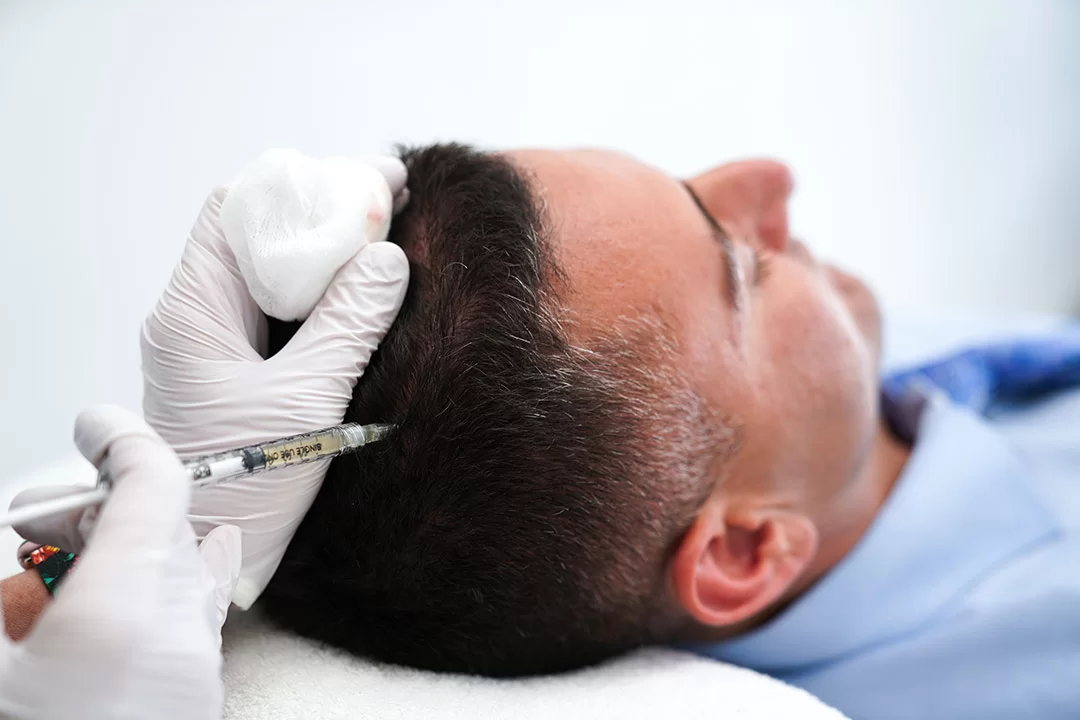
PRP (Platelet-Rich Plasma) is a natural treatment in which your own platelets are used to stimulate the hair follicles and increase blood circulation.

do you experience hair loss?
Free consultation — no obligation, just a first step towards understanding what's right for you. Choose the clinic that suits you best.